

What Decal Material Lasts Longest Outdoors? A Spec-by-Spec Comparison
The longest-lasting outdoor decal is cast vinyl under a UV-stable overlaminate, which 3M rates at 8 years for its standard printed-and-laminated construction. Polyester with a polyester overlaminate runs 5 to 8 years. Polymeric calendered vinyl falls well short of both, and economy monomeric film can be finished inside a year. But the material is only half the answer — orientation, climate, and how the decal fails matter as much as what it's made of.

The longest-lasting outdoor decal is cast vinyl under a UV-stable overlaminate, which 3M rates at 8 years for its standard printed-and-laminated construction. Polyester with a polyester overlaminate runs 5 to 8 years. Polymeric calendered vinyl falls well short of both, and economy monomeric film can be finished inside a year. But the material is only half the answer — orientation, climate, and how the decal fails matter as much as what it's made of.
The longevity table

Alt text: "Outdoor decal service life by material: cast vinyl with UV overlaminate 8 years, unprinted cast vinyl 8–10 years, polymeric calendered vinyl 5–7 years, monomeric calendered vinyl up to 1 year, printed polyester 5–8 years — vertical exterior exposure."
Read these figures carefully, because they are not like-for-like. Manufacturers publish durability for different conditions, and the difference is large. An unprinted film rating — 3M rates cast Scotchcal 3650 at 10 years white, Avery rates its 777 cast film at up to 8 — describes bare film with no ink and no laminate on it. That is not a decal. A finished graphic gets printed, and printing is what introduces the weakest link. The honest basis for a real-world decal is the printed-and-laminated figure, which is why 8 years is the number we quote for cast work rather than 10.
One more caveat worth stating plainly: most published durability figures are based on middle-European or Asia-Pacific exposure conditions. A film rated 8 years in Northern Europe is not an 8-year film in Phoenix or on the Gulf Coast.
The cast-versus-calendered gap is manufacturing, not marketing
Cast vinyl is poured as a liquid onto a casting sheet, so the film carries almost no internal stress. Calendered vinyl is squeezed through heated rollers, which stretches the film and leaves it wanting to shrink back for the rest of its life. That built-in memory is why calendered decals shrink, crack, and lift years sooner. See the glossary entry on calendered vs cast vinyl [link: /glossary/calendered-vs-cast-vinyl] for the quick version.
Orientation costs you half your service life
This is the single most underestimated number in decal specification. Avery Dennison's performance guarantee states that rated durability "is reduced by 50% for horizontal applications" — and it applies the same 50% cut to anything more than 10° off vertical. Hoods, roofs, equipment decks, and sloped panels all fall in that bracket. An 8-year laminated cast decal on a truck door is a 4-year decal on the hood of the same truck.
Two mechanisms drive it. Horizontal surfaces take direct rather than glancing UV, and they hold standing water and road chemicals against the face instead of shedding them. Avery also notes a further one-year deduction for stationary graphics facing south, west, or southwest.
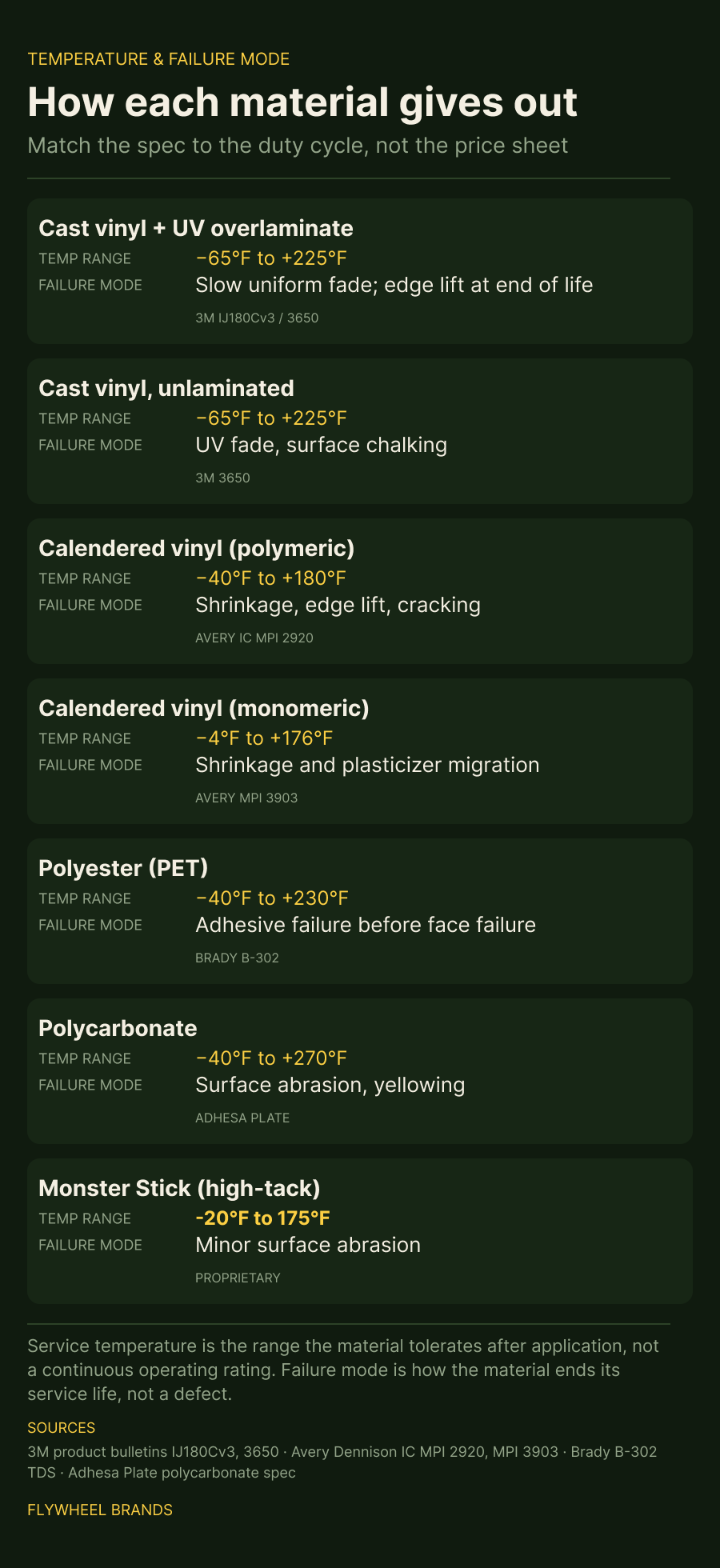
How outdoor decals actually fail
Alt text: "Service temperature range and typical failure mode by decal material: cast vinyl −65°F to +225°F failing by slow fade and edge lift; polymeric calendered −40°F to +180°F failing by shrinkage and cracking; polyester −40°F to +230°F failing at the adhesive."
Edge lift. The most common failure on fleet work. The adhesive at the decal's perimeter loses grip — from pressure-washing, road film creeping under the edge, or shrinkage pulling the film inward — and once an edge lifts, water and grit finish the job. Worth knowing: 3M explicitly excludes edge lifting and minor cracking from its warranty as normal weathering, not product failure.
Plasticizer migration. Monomeric calendered films are loaded with plasticizers to stay flexible. Heat drives those compounds out of the film and into the adhesive, leaving the face brittle and the bond gummy. It is why a bargain decal looks fine at year one and cracks like eggshell at year three — and why Avery rates its monomeric promotional film at up to one year outdoors rather than several.
Adhesive bake. Color drives surface temperature more than most buyers expect. Lawrence Berkeley National Laboratory measured a black car roof running as much as 45°F hotter than a silver one under the same sun. Every degree of that lands on the adhesive: some crosslink and go brittle, others soften and ooze, and either way the bond becomes the weak point before the face film does. Spec adhesive for the dark panels on a mixed fleet, not the light ones.
UV fade. The sign-shop rule of thumb that "reds and yellows go first" is a useful approximation with a misleading explanation. What actually governs fade is the pigment's chemical class, not its hue. Organic pigments break down faster than inorganic ones, and the organic pigment families commonly used for yellows, oranges, and reds in commercial ink sets are less lightfast than the phthalocyanine families used for blues and greens — which is where the folklore comes from. Swap to an inorganic red or yellow, such as an iron oxide, and the ranking reverses. Ask what pigment chemistry your printer is using, not just what color.
A note on lamination. An overlaminate is the cheapest life extension available, but it does not simply add years. 3M is explicit: durability "follows from the component with the lowest statement and cannot be extended by use of a longer lasting overlaminate." A premium laminate over a weak base film or a fugitive ink buys you very little. Spec the construction as a system.
What climate does to the numbers
Every figure in the table moves with geography. High-UV, high-heat regions shorten face-film life and bake adhesives. Coastal salt attacks adhesive edges and any metallic element. Freeze-thaw climates work micro-cracks open every winter — water gets in as liquid, expands as ice. Wet, low-UV regions like the Pacific Northwest are gentlest on pigment but hardest on edges, because the decal rarely fully dries. Spec for the worst environment the vehicle sleeps in, not the average one.
Frequently asked questions
How long do vehicle decals last?
Laminated cast-vinyl fleet decals are rated around 8 years on vertical surfaces. Polymeric calendered films run shorter, and economy monomeric films can be finished inside a year. Halve any of those figures for horizontal surfaces — Avery Dennison applies a flat 50% reduction to non-vertical applications — and expect further shortening in high-UV regions.
Does lamination extend decal life?
Yes, but not additively. A UV-stable overlaminate shields pigments from UV, absorbs abrasion that would otherwise scuff the printed face, and seals the print against chemicals and washing. What it cannot do is outrun the weakest component: 3M states that a construction's durability follows the shortest-rated element in it. Laminate over a good base film and ink, and you get the rated life; laminate over a cheap film and you don't.
Why do decals crack in winter?
Cold makes vinyl brittle while the substrate beneath it contracts, and calendered films add their own built-in shrinkage stress from manufacturing. Micro-cracks open, water enters as liquid and expands as ice, and each freeze-thaw cycle drives the cracks wider. Cast films and properly matched adhesives tolerate this cycling far better — the reason northern fleets spec cast.
Spec the material to the duty cycle
Material is one line in the full specification — adhesive, surface energy, laminate, and application method decide the outcome together. Start with the Industrial Print Solutions specification guide, see the Custom Vinyl Decals page for standard fleet work, or go straight to Monster Stick if the environment eats normal decals. Or tell us the vehicle, the climate, and the wash schedule — we'll spec it from service history, not a warranty table.
Our insights
Vinyl vs. Polyester Labels: Which Should You Choose?
UL 969 vs. UL 969A: Which Standard Applies to Your Label?
What Decal Material Lasts Longest Outdoors? A Spec-by-Spec Comparison

Find your ultimate branding solution.
Got some ideas but not sure how to execute?