





Pressure-Sensitive Adhesive (PSA)
Acrylic PSAs dominate outdoor industrial work because they resist UV, heat, and plasticizer migration, and their bond strengthens over 24–72 hours as the adhesive wets out into the substrate. Rubber-based PSAs deliver higher initial tack and bond better to low-surface-energy plastics, but degrade faster outdoors. Adhesive choice is driven by the substrate’s dyne level, service temperature, and whether the label must ever come off cleanly.

Kiss-Cut vs. Butt-Cut
Kiss-cutting cuts through the face material and adhesive but leaves the liner intact, so the decal stays on its backer until peeled. Butt-cutting cuts through face and liner together, separating each label completely. Specify kiss-cut for hand application and non-rectangular shapes; butt-cut for speed, volume, and rectangles.
Kiss-cut labels ship on sheets or rolls with the surrounding matrix weeded away, which makes them easy to pick and apply by hand and allows any die shape. Butt-cut labels are simply guillotined apart — cheaper and faster, well suited to high-volume rectangular runs, but every label is loose and has no exposed liner edge to grab. Steel rule dies add tooling cost; digital die-cutting removes it at lower volumes.

Overlaminate
An overlaminate is a clear film bonded over a printed decal to protect the ink from abrasion, UV, chemicals, and repeated cleaning. It is a separate layer laid on top of the graphic rather than a coating sprayed onto it, and it is usually what determines how long a printed decal survives outdoors or in a wash-down environment.
Overlaminates are specified by film chemistry and by finish. Cast vinyl laminates pair with cast printed film for conformable, long-term outdoor graphics; polyester and polycarbonate laminates add chemical and abrasion resistance on equipment panels. Finish matters as much as durability — gloss saturates color, matte kills glare on operator-facing panels, and textured laminates add slip resistance for floor and step graphics. Match the laminate to the face film: a cast print under a calendered laminate will still shrink and lift.

Domed Decal
A domed decal is a printed decal covered with a clear polyurethane resin that self-levels into a raised, lens-shaped dome. The resin adds a three-dimensional look, magnifies the artwork beneath it, and forms a hard, UV-stable, chemically resistant shell — commonly used for nameplates, equipment badges, and brand emblems.
Doming happens after printing and cutting: measured polyurethane is dispensed onto each piece, surface tension pulls it out to the die-cut edge, and it cures to a permanently flexible, non-yellowing finish. Polyurethane is specified over epoxy for outdoor work because epoxy ambers under UV. Domed decals resist solvents, salt, and impact far better than flat printed decals, which is why they hold up on equipment exteriors, machinery, and vehicles.

Subsurface Printing
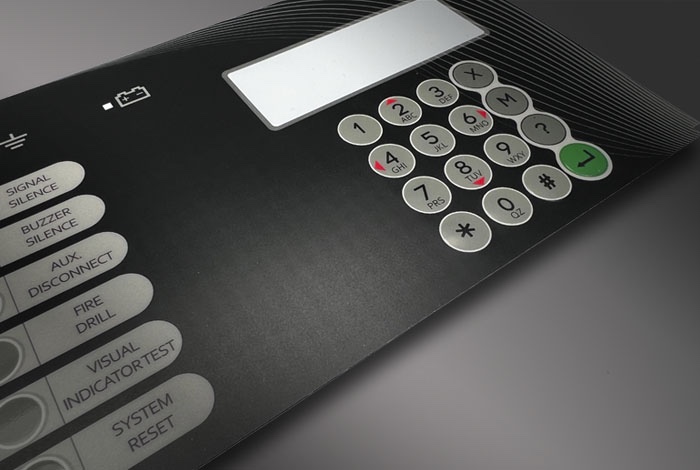
Subsurface printing places the ink on the back of a clear film rather than the front, so the film itself becomes the wear layer and the graphics are viewed through it. Because nothing can abrade, scratch, or chemically attack the ink, subsurface-printed parts survive cleaning, handling, and high-cycle use that would destroy surface printing.
It is the default construction for graphic overlays, membrane switches, and instrument panels printed on polyester or polycarbonate. The artwork must be mirrored before printing, and colors are laid down in reverse order, with opaque white typically printed last as a backing layer.
The trade-off: subsurface printing requires a transparent substrate and adds a process step, so surface printing remains standard for vinyl decals and general labels.

Edge Lift
Edge lift is the failure mode where a decal’s perimeter releases from the substrate and curls upward while the center stays bonded. It is caused by film shrinkage, insufficient adhesion on a low-surface-energy or contaminated surface, or applying a film across a curve it cannot conform to.
Calendered vinyl is the most common culprit: the internal stress from its manufacturing process pulls the film inward as it ages, and a compound curve accelerates it. Contamination — wax, silicone, oil, or powder-coat release agent — is the second cause, and surface prep with isopropyl alcohol prevents most of it. The fixes are specification-side, not field-side: cast film for curves, a higher-tack adhesive on plastics, and post-heating to relieve stress at application.

Tack
Tack is how fast a pressure-sensitive adhesive grabs a surface on first contact, under light pressure and a dwell of a second or two. It measures the adhesive's ability to wet a surface instantly — a flow property, not bond strength. High tack does not predict high final adhesion.
Loop tack is the usual method (FINAT FTM 9, ASTM D6195), reported in newtons per 25 mm; label adhesives typically fall between 2 and 15 N/25 mm. Rolling-ball tack (ASTM D3121) reports distance rolled, so a shorter number means higher tack — an easy misreading. The probe tack standard, ASTM D2979, was withdrawn in 2019 with no replacement, so cite it only with that caveat.

Peel Adhesion
Peel adhesion is the force per unit width needed to pull a pressure-sensitive label off a surface at a controlled angle, speed and dwell. It is the number most datasheets lead with, and it means nothing without the method, test panel and dwell time stated next to it.
FINAT FTM 1 peels at 180° from float glass at 300 mm/min and reports at both 20 minutes and 24 hours; ASTM D3330 and PSTC-101 use stainless steel and test within about a minute. FINAT reports N/25 mm, PSTC N/10 mm — a 2.5× difference for the same adhesive. Removable stocks sit near 2–8 N/25 mm at 24 hours; permanents run above 10. Always quote both dwell figures.

Shear Adhesion and SAFT
Shear adhesion measures an adhesive's resistance to a constant load applied parallel to the bond — its cohesive strength, or how well it holds to itself. The result is a time to failure, not a force. It governs hot and vertically loaded applications, where a peel number tells you nothing useful.
ASTM D3654 and PSTC-107 hang 1,000 g from a 12 × 12 mm bond at a 2° tilt; FINAT FTM 8 uses 25 × 25 mm. SAFT — shear adhesion failure temperature — runs the same geometry in a ramped oven and reports a temperature. Its former standard, ASTM D4498, was withdrawn in 2021, so state load, ramp rate and geometry explicitly.

Corona Treatment
Corona treatment raises a plastic's surface energy by passing a high-voltage discharge across it, oxidising the top few nanometres and grafting polar groups onto an otherwise non-polar surface. It is how polypropylene and polyethylene are made printable and bondable without altering the bulk material underneath.
Untreated polypropylene sits near 29–31 dynes/cm; treatment can push past 42, with 36–44 the practical target depending on the ink or adhesive. The effect decays — polymer chains reorient and additives bloom to the surface, so treatment can fade measurably within weeks. Verify dyne level on aged roll stock rather than trusting the mill certificate. No standard governs the treatment itself; ASTM D2578 governs measuring the result, and it is a visual dyne-solution method, not a precision one.

Adhesion Promoter
An adhesion promoter is a thin chemical tie-layer applied between a surface and an adhesive, bonding to both. Unlike corona or flame treatment, which modify the existing surface, a promoter adds material — so it does not decay, but it adds a process step and a layer that can fail on its own.
The chemistry has to match the surface. Chlorinated polyolefins anchor into polypropylene, polyethylene and TPO. Silane coupling agents bond to glass, silica and metal oxides through surface hydroxyls, which polyolefins do not have — a silane primer on polypropylene is chemically pointless. No standard defines the product class, so verify by peel and shear testing on the primed system and specify by manufacturer part number.

Substrate
In labelling, the substrate is the surface a label is applied to — the drum, panel, housing or enclosure. It is distinct from facestock, the material the label itself is made of. Substrate properties, above all surface energy and texture, drive adhesive selection more than any other single variable.
The term is used inconsistently, and a specification should say which layer it means. In printing contexts substrate often means the material being printed on, which for a label press is the facestock. ASTM D907, the adhesives terminology standard, defines substrate as the material an adhesive is spread onto — pointing at the facestock rather than the applied-to surface. Name the layer, not just the word.

Mil Thickness
A mil is one thousandth of an inch — 0.001 in, or 25.4 microns. It is the standard caliper unit for decal films, label stocks and graphic overlays. A mil is not a millimetre, and caliper does not indicate durability: the thinner film is frequently the longer-lasting one.
Cast vinyl runs about 2 mil, calendered vinyl 2.5–4 mil, polyester label stock 1–2 mil, and polycarbonate overlays 7–15 mil. Yet 2 mil cast film outlasts 3–4 mil monomeric calendered by years, because durability follows the manufacturing process and plasticiser chemistry rather than thickness. Measure film to ASTM D6988 and finished adhesive constructions to ASTM D3652. Adhesive caliper on datasheets is often calculated from coat weight rather than measured, so it is a poor inspection criterion.

Accelerated Weathering (QUV)
Accelerated weathering exposes a material to cycles of intense UV, heat and moisture to force in weeks the degradation that would take years outdoors. ASTM G154 uses fluorescent UV lamps with a condensation step; ASTM G155 uses a xenon arc with water spray to simulate the full solar spectrum.
Test hours cannot be converted to outdoor years. Q-Lab, which builds the equipment, calls a universal conversion factor theoretically impossible — weather at a single site varies as much as 2:1 year to year. The data is comparative: it ranks materials against each other under an identical cycle. Treat any claim that a given number of QUV hours equals a service life in years as unsupported.

Plasticizer Migration
Plasticisers make PVC film flexible but are not chemically bonded to it, so they migrate out over time into any absorbent neighbouring layer — usually the adhesive. The film shrinks as they leave and the adhesive softens as they arrive, which is why the failure always shows up at the edges.
Symptoms are shrinkage, edge lift, tunnelling, adhesive ooze and staining, and eventually cracking. Because the adhesive loses cohesive strength, this is a shear failure rather than a peel failure, and shear testing is what diagnoses it. Monomeric plasticisers are short-chain and migrate readily; polymeric ones are long-chain and hold. No standardised timescale exists — rates depend on formulation, temperature, pressure and solvent exposure.

Die-Cutting: Steel-Rule vs Digital
Die-cutting shapes a label or decal with physical tooling; digital cutting does the same with a laser or drag knife and no tooling at all. The choice is driven by run length, material and tolerance — hard tooling amortises over volume, digital wins on short runs and changing shapes.
Steel-rule dies are bent blade set in a flatbed base: inexpensive tooling, adjustable depth, and the loosest tolerance at roughly ±0.010–0.015 in. Flexible dies on a magnetic cylinder are the common rotary choice. Solid milled dies cost the most and hold ±0.005–0.010 in. Lasers reach ±0.001–0.005 in but cannot cut PVC, which releases chlorine gas. No standard specifies label die-cutting tolerances anywhere — every figure above is common industry practice, not a governed value.
UL 969
UL 969 is the UL standard for marking and labeling systems. It certifies a label as a complete system, facestock, ink, adhesive and substrate evaluated together for permanence and legibility after exposure to water, temperature cycling, humidity, UV and chemicals. Recognition applies to a specific construction on specific surfaces, not to a company.
Each recognized construction carries its own substrate list and operating temperature range, commonly between −40 °C and 150 °C. The standard is referenced in over 450 UL and 30 ULC end-product standards, which is why procurement treats it as a qualification gate: a non-recognized label can jeopardize the end product's own certification. Recognition is maintained under Follow-Up Service, unannounced factory inspections, and is verifiable in UL
Our work showcase
Take a look at some of our recent work featured below. From bold signage to intricate custom labels, our print solutions are designed to make an impact. Let these projects inspire your next big idea!








What Decal Material Lasts Longest Outdoors? A Spec-by-Spec Comparison

Flywheel is our go-to source for stickers! Whether it’s for operational purposes to keep things running efficiently or advertising for lenders and other parties by the thousands, Flywheel gets it done and gets it done fast”

In today's world, you want a partner that will think about your clients as if they are your own, and Flywheel does that...I don't have to worry about looking for another vendor or try to price shop my way to saving pennies. I know I have the perfect combination of customer service and cost with Flywheel."
Flywheel has helped us with everything from our brand refresh to choosing the right promotional products for a trade show. Their full-service partnership has been integral in our marketing for a few years now, and we look forward to continuing that relationship.”

Representing a nonprofit organization, my purchasing decisions are more budget-sensitive than most, and I find that Flywheel's pricing is beyond competitive. From promotional items to print and graphics work, they've become my go-to, and I appreciate the sense of partnership they've worked so hard to cultivate."
Marketing isn’t always about spending a lot of money. Flywheel has helped us to find cost-effective solutions that have a big impact on our efforts, from pens to our employees’ uniforms. Their high-level service makes them an easy choice as a creative partner.”
.webp)
The Maryland Underground Facilities Damage Prevention Authority (the Authority) has utilized the services of Flywheel for a number of years with ever increasing confidence. As providers of promotional items we have found them to be reasonable, reliable and timely.
Our retail presence is so critical to the growth of our company. It was reassuring to be able to partner with Flywheel, knowing that they fully understand our brand, our image and our audience.”

We appreciated being able to rely on Flywheel to not only choose the right custom apparel for our marketing campaign but also deliver the product exactly as promised.”
.webp)
Flywheel is our go-to for all of our merch and apparel. With Flywheel we know we are going to get a fast turnaround on our orders, quality goods, and a competitive price.
Flywheel is great to work with. A wide variety of customizable options and customer service is quick to respond and adjust “on the fly."
Awesome company! Super fast service, super high quality!
John Langworthy and the Flywheel team were absolutely fantastic to work with. Every detail was given the highest of attention, which made me as the customer have peace of mind that our exhibit show would go smoothly, and be a huge success with our new booth. I have worked with other companies previously, and the bar that John and his team set and way over exceeded will keep me as a satisfied customer for a long time.
I just wanted to pass along my thanks for the incredible work and service that you and Flywheel have provided Sulzer this past year. I am sure we are not your largest account, but you have made us feel immeasurably valuable.

Got some ideas but not sure how to execute?